Tarantula Collection Update | Fresh Molts, Feeding & an OBT Surprise | Journal Entry #2
Every collection has a story.
Some days in the hobby are carefully planned.
Others simply unfold on their own.
Journal Entry #2 captures one of those days where several small moments came together to tell a much bigger story. A fresh molt revealed new colors, feeding time offered a closer look at each spider's personality, and one particularly confused Orange Baboon Tarantula (OBT) reminded me that tarantulas rarely follow the script.
While no single event would normally deserve an entire video, together they perfectly represent why I started The Tarantula Journal in the first place.
Sometimes the best chapters are simply everyday moments.
A Fresh Molt
Few experiences in tarantula keeping are as rewarding as discovering a successful molt.
Beyond allowing the spider to continue growing, each molt often reveals subtle changes in coloration, pattern, and personality. It's a reminder that every individual in the collection is constantly changing, even during periods when very little seems to happen.
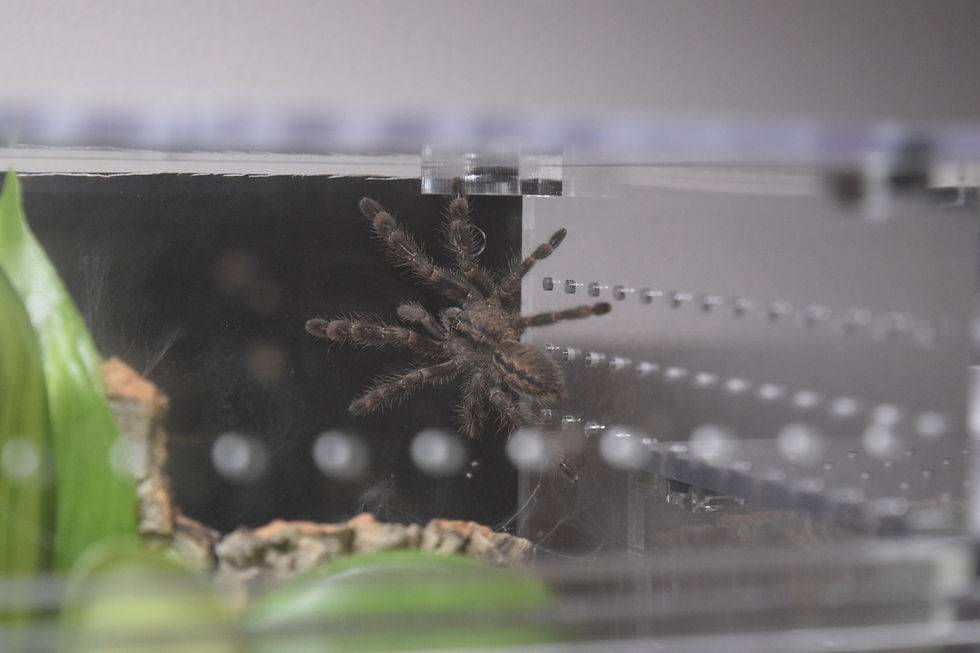
My Poecilotheria vittata molted, and with this molt it put on significant size and now has some new coloration on its ventral side primarily along the legs.
Watching those changes unfold over months—and eventually years—is one of the reasons I enjoy documenting this collection.
Feeding Day
Feeding provides some of the most fascinating opportunities to observe natural behavior.
Some tarantulas respond instantly, rushing toward prey with incredible speed and precision.
Others take a slower, more deliberate approach before finally committing.
Those differences are part of what makes each species—and each individual—interesting to watch.
One Very Confused OBT
If you've kept tarantulas long enough, you've probably experienced moments where a spider completely ignores your expectations.
That happened during this Journal Entry.
Instead of behaving like the fast, confident predator it's often known to be, my Orange Baboon Tarantula seemed completely unsure of what it wanted to do. It knew there was a meal snared in its webbing, however as soon as it emerged from its web tunnel the dubia roach froze. The Orange Baboon Tarantula searched high and low in its enclosure for close to thirty minutes, crawling right over the roach several times. This was a great demonstration of what senses these spiders rely on when hunting. For this OBT sight clearly wasn't part of its hunting plan.
Moments like that are part of what makes documenting a real collection so enjoyable.
The spiders don't follow a script.
Every Journal Entry captures whatever story they decide to tell that day.
Why I Document the Small Moments
It's easy to think only the biggest events deserve to be recorded.
A new species.
A rehousing.
A massive molt.
But over time I've realized that a collection is really built from hundreds of small moments.
Watching a spider settle into its enclosure.
Seeing new excavation
Seeing new webbing appear overnight.
Discovering a fresh molt before work.
Those quiet moments are every bit as meaningful as the major milestones.
Watch Journal Entry #2
Watch the full Journal Entry below to experience these moments as they happened.
Related Species
Orange Baboon Tarantula Care Guide
Pinktoe Taranutla Care Guide
Togo Starburst Baboon Tarantula Care Guide
Indian Ghost Ornamental Tarantula Care Guide
Species Library
Journal Note
One thing I've already learned from creating The Tarantula Journal is that I don't need extraordinary events to tell interesting stories. Sometimes a single molt, an evening feeding, or an unexpected behavior becomes a reminder of why I enjoy this hobby so much.
Those ordinary moments are what I hope to remember years from now.
Because every collection has a story.
Comments